Nema 17 Stepper Motor Price in Pakistan
Buy a Nema 17 stepper motor in Pakistan for 3D printers, laser engravers, camera sliders and light CNC axes. 4-wire, 6-wire and long-shaft motors, brackets and dampers. Check live prices below. COD and 24-48 hour delivery. Part of our stepper motor range.
Showing 1 – 18 of 18 results
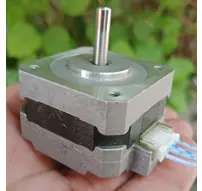
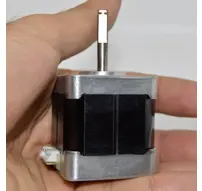
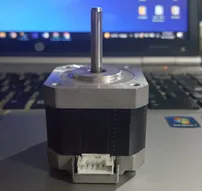
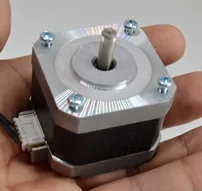
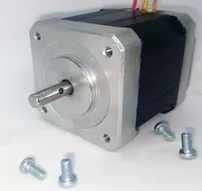
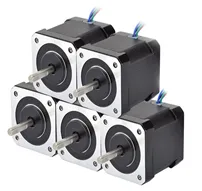
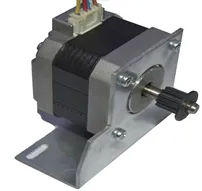
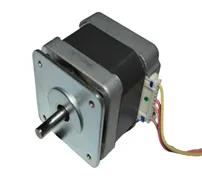
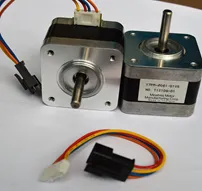
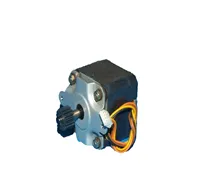
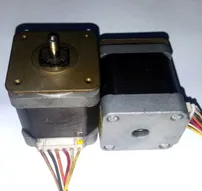
Nema 17 Stepper Motor Price in Pakistan
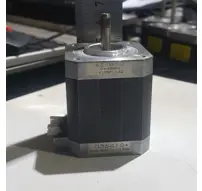
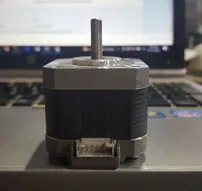
The Nema 17 stepper motor price in Pakistan depends on body length, rated current, holding torque and brand. Standard 1.8° motors for 3D printers are the most affordable, while branded motors with higher torque, such as the Shinano Kenshi STP-42D4042, cost more. We do not print fixed prices because they change often. The table lists our current Nema 17 models; open any product card for the live price and stock.
Live prices and stock for today: open any product card above. Prices change often.
Ask a Stepper Motor Specialist on WhatsAppFaceplate
Standard Nema 17 square face, the same on every body length.
Hole Spacing
Four M3 mounting holes on a 31 mm square with a 22 mm pilot.
D-Shaft
Match with 5 mm bore GT2 pulleys, couplers and hubs.
Winding Types
Bipolar 4-wire and centre-tapped 6-wire motors.
| Model | Type |
|---|---|
| Nema 17 Stepper Motor | Standard bipolar |
| Nema 17 Stepper Motor 4 Wire | 4-wire bipolar |
| Nema 17 Stepper Motor 6 Wire Bipolar | 6-wire |
| Nema 17 Stepper Motor 1.0A | 1.0 A rated |
| Nema 17 Stepper Motor Long Shaft | Long shaft |
| MINEBEA Nema 17 | Branded, 3D printer / CNC |
| KV4239-N3B002A, 5 mm shaft | 4-wire bipolar |
| ML17A3 bipolar 4 wires | 4-wire bipolar |
| Bipolar 1.8°, 1.6 ohm | For 3D printer, robotics |
| Shinano Kenshi STP-42D4042 | 2 A, 0.53 Nm |
| 42BYGHW804 IM42HS60 | For 3D printer and CNC |
Not sure which model fits your machine? Ask our team on WhatsApp and share your driver and printer or CNC model.
What Is a Nema 17 Stepper Motor?
A Nema 17 is a hybrid stepper motor with a 42 mm (1.7 inch) square faceplate. The number describes only the mounting size. Most Nema 17 motors have a 1.8° step angle (200 steps per revolution), two phases and a 5 mm shaft, and they are driven by a stepper driver rather than powered directly.
Nema 17 is the default motor for FDM 3D printers, small laser engravers, plotters, camera sliders and light CNC axes because it is compact, affordable and easy to drive. If your machine needs more torque, step up to a Nema 23 stepper motor.
Nema 17 Specifications
Exact figures change by model and body length, so always check the datasheet. The table shows what you can expect across the Nema 17 range.
| Parameter | Typical value |
|---|---|
| Step angle | 1.8° (200 steps/rev); 0.9° versions exist (400 steps/rev) |
| Faceplate | 42.3 × 42.3 mm |
| Body length | Pancake about 20 mm; standard 34, 40, 48 and 60 mm |
| Holding torque | About 0.15 Nm (pancake) up to about 0.65 Nm (long body) |
| Rated phase current | About 0.4 A to 2.5 A depending on model |
| Rated voltage | About 2 V to 12 V per phase (not the supply voltage) |
| Shaft diameter | 5 mm, flat (D-cut) |
| Wiring | 4-wire bipolar or 6-wire (centre tapped) |
| Insulation class | Class B (130 °C winding), case up to about 80 °C is normal |
Torque conversion
Torque appears in different units on different datasheets. 1 Nm equals 100 Ncm, about 10.2 kg·cm, or about 141.6 oz·in. A motor listed at 0.53 Nm is the same as 53 Ncm or about 75 oz·in.
Nema 17 Mounting Dimensions
The Nema 17 mounting pattern is four holes on a 31 mm square, with a 22 mm pilot (boss) diameter and M3 screws. The faceplate is 42.3 mm square. Every Nema 17 motor, whatever its body length, uses this same pattern, so brackets and dampers fit all of them.
| Dimension | Value |
|---|---|
| Faceplate | 42.3 × 42.3 mm |
| Hole spacing | 31 mm square |
| Mounting screws | M3 |
| Pilot / boss diameter | 22 mm |
| Shaft diameter | 5 mm (D-cut) |
| Body length | Varies: about 20 to 60 mm |
Need a bracket? We list Nema 17 mounting brackets, and rubber vibration dampers.
Nema 17 Stepper Motor Wiring and Pinout
4-wire bipolar motor
A 4-wire motor has two coils, called Phase A and Phase B. Two wires that show low resistance between them belong to the same coil. A common colour convention is black and green for one coil and red and blue for the other, but colours vary between makers, so always confirm with a multimeter before you connect the driver.
Wire one coil to the 1A and 1B outputs of the driver and the other to 2A and 2B. If the motor turns the wrong way, swap the two wires of one coil or invert the direction in firmware.
6-wire motor
A 6-wire motor has a centre tap on each coil. Two end wires plus one centre wire make up each coil. To run it on a standard bipolar driver, connect only the two end wires of each coil and leave the centre taps insulated. Do not join the centre tap to an end wire, as that changes the winding and the current rating.
To identify the wires, measure resistance. The centre tap to either end of the same coil reads half of the end-to-end value. Wires from different coils show no continuity.
Which Driver for a Nema 17 Motor?
| Driver | Motor supply | Current | Notes |
|---|---|---|---|
| A4988 | 8 – 35 V | About 1 A without a heatsink, up to about 2 A with cooling | Budget choice for 3D printers; up to 1/16 microstepping |
| DRV8825 | 8.2 – 45 V | About 1.5 A without cooling, up to 2.2 A with cooling | Up to 1/32 microstepping; set VREF with care |
| TMC2209 | 4.75 – 29 V | About 2 A RMS | Very quiet; popular on newer 3D printer boards |
| TB6600 or DM542 | 9 – 42 V or 20 – 50 V | Up to about 4 A | Standalone drivers for 2 A+ Nema 17 or CNC use |
Check the exact limits on the driver you buy, as boards from different makers differ. Browse our motor drivers collection for a matching stepper driver. Match the driver current to the rated current of the motor, not the other way around.
How to set VREF on an A4988 or DRV8825
The driver current limit is set by turning the small potentiometer while measuring VREF. The formulas depend on the sense resistor (Rs) fitted on your board:
- A4988: Current limit = VREF ÷ (8 × Rs). On many boards Rs is 0.1 Ω, so VREF = current × 0.8. For a 1.0 A motor, VREF is about 0.8 V. Boards with a 0.068 Ω resistor need a different value, about 0.54 V for 1.0 A.
- DRV8825: Current limit = VREF × 2 on boards with 0.1 Ω resistors. For a 1.0 A motor, VREF is about 0.5 V.
Set the current to about 70 to 80 percent of the rated current of the motor for cool, reliable running, and increase it only if you see skipped steps.
What Voltage Does a Nema 17 Motor Need?
The voltage printed on the motor is its rated coil voltage, not the supply voltage. A motor rated 1.7 A at 2.8 V does not need a 2.8 V supply. A chopper driver such as the A4988 or TMC2209 limits current, so you can power the driver from 12 V or 24 V and the motor still draws only the set current.
Most Nema 17 setups use 12 V or 24 V. 24 V gives better torque at speed than 12 V. Stay within the driver limit, and use a regulated power supply with enough current for all motors.
Nema 17 Motor Speed (RPM)
Stepper torque drops as speed rises. Most Nema 17 motors give useful torque up to about 600 to 1,000 RPM at 24 V, and much less on 12 V. For a belt-driven axis with a 20-tooth GT2 pulley, 600 RPM moves the belt at about 24 m/min. Check the torque-speed curve of the motor if you need high speed.
0.9° vs 1.8° Nema 17 Motors
A 1.8° motor takes 200 steps per revolution; a 0.9° motor takes 400. The 0.9° version has finer resolution but usually lower torque at speed, and it needs your controller to send twice as many pulses for the same movement. Most 3D printers and CNC machines use 1.8° motors with microstepping, which gives smooth motion without the extra pulse load.
Nema 17 vs Nema 23: Which One Do You Need?
| Choose Nema 17 if | Choose Nema 23 if |
|---|---|
| You are building a desktop 3D printer, laser engraver, plotter or camera slider | You drive a CNC router, plasma table or heavy gantry |
| Your axis moves light parts at moderate speed | You need holding torque above about 1 Nm |
| You use an A4988, DRV8825 or TMC2209 | You can use a TB6600, DM542 or DM556 and a 24–48 V supply |
See the full Nema 23 stepper motor range, or browse every stepper motor we list.
Nema 17 Accessories
Vibration dampers
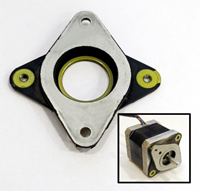
Rubber and steel dampers isolate motor vibration from the frame, which reduces noise and print ghosting on 3D printers. Use dampers that match the 31 mm hole pattern. See our Nema steel and rubber vibration dampers.
Mounting brackets
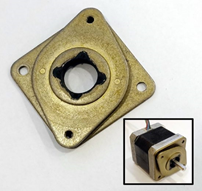
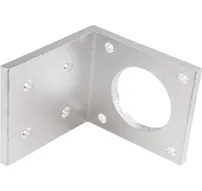
An L-shaped bracket mounts the motor to a plate or extrusion. See the Nema 17 mounting bracket.
Pulleys and couplers
Match the 5 mm shaft with a 5 mm bore GT2 pulley or coupler. Find them in CNC parts and accessories or 3D printer parts.
Custom parts
Need a special motor adapter or enclosure? Order it through our 3D printing service, or request a custom driver board through PCB design services.
Nema 17 with Arduino and CNC Shield
A Nema 17 stepper motor connects to an Arduino through a stepper driver, never directly to the board. The usual setup is an Arduino Uno with a CNC shield, an A4988 or DRV8825 driver module for each motor, and a 12 V to 24 V supply. The Arduino sends step and direction pulses, and the driver powers the coils. This setup is used for GRBL plotters, small engravers and robot projects. Pick up an Arduino and a regulated power supply from Rawlix to complete the build.
Nema 17 Troubleshooting
Motor vibrates but does not rotate
The coil pairs are probably wired wrongly. Measure resistance to find the real pairs, and check that VREF is not set too low.
Motor loses steps in one direction
Check for a loose pulley grub screw on the D-shaft flat, a binding belt or rail, or too high an acceleration setting.
Motor runs hot
Lower the driver current limit. A case temperature up to about 80 °C is within normal limits for steppers, but it should not smell or burn the plastic mount.
Driver overheats
Add a heatsink and airflow. A4988 and DRV8825 boards shut down when they overheat; reduce current or move to a TMC2209 or a standalone driver.
Popular Uses for Nema 17 Motors in Pakistan
3D printers
X, Y and Z axes and extruder drive. Browse 3D printers.
Laser engravers and plotters
smooth, low-noise motion.
Camera sliders and pan-tilt heads
quiet, repeatable moves.
Small CNC and PCB milling
light axes with low cutting loads.
Frequently Asked Questions About Nema 17 Stepper Motors
What is the Nema 17 stepper motor price in Pakistan?
The Nema 17 stepper motor price in Pakistan depends on body length, current rating, torque and brand. Standard 4-wire, 6-wire and long-shaft motors are the most affordable, and branded higher-torque motors cost more. See the live price on each product card above.
What does Nema 17 mean?
Nema 17 refers to a 1.7 inch (about 42 mm) square motor faceplate and its mounting hole pattern. It says nothing about torque or current, which depend on the body length and winding.
What is the mounting hole spacing of a Nema 17 motor?
The four mounting holes are on a 31 mm square. The motor has a 22 mm pilot diameter and uses M3 screws. The faceplate is 42.3 mm square.
What is the maximum voltage for a Nema 17 motor?
The motor rated voltage is only the coil voltage at rated current. The supply voltage is set by the driver, usually 12 V to 24 V for A4988, DRV8825 and TMC2209 drivers. Stay within the driver maximum, and never exceed it.
What driver should I use with a Nema 17 motor?
Use an A4988 for motors up to about 1.2 A, a DRV8825 or TMC2209 for motors up to about 1.7 A to 2 A, and a TB6600 or DM542 for 2 A or higher.
How do I connect a 6-wire Nema 17 to a 4-pin driver?
Find the two end wires of each coil with a multimeter, connect those four wires to the driver, and leave the two centre-tap wires unconnected and insulated.
How do I set VREF on an A4988?
Use VREF = current × 8 × Rs. For boards with a 0.1 Ω sense resistor, a 1.0 A limit needs about 0.8 V. Measure on the potentiometer, and set the current to 70–80 percent of the motor rating.
What is the difference between a 1.8° and a 0.9° Nema 17?
A 1.8° motor needs 200 steps per revolution; a 0.9° motor needs 400. The 0.9° motor has finer resolution, while most printers and routers use 1.8° motors with microstepping.
How fast can a Nema 17 motor run?
Most Nema 17 motors give usable torque up to roughly 600 to 1,000 RPM at 24 V. Torque falls as speed rises, so check the torque-speed curve for your model.
Can I use a Nema 17 motor for a CNC router?
Yes for small, light machines such as engravers and PCB mills. For routers cutting wood or aluminium, a Nema 23 stepper motor is the safer choice because it gives much more torque.
Can I connect a Nema 17 stepper motor to an Arduino?
Yes, through a stepper driver such as the A4988 or DRV8825. Connect the motor coils to the driver, the driver step and direction pins to the Arduino, and power the driver from a separate 12 V to 24 V supply.
What delivery times can I expect for Nema 17 orders in Pakistan?
Orders are dispatched by courier. Delivery to Lahore, Karachi, Islamabad and Rawalpindi typically takes 24 to 48 hours, and Cash on Delivery is available.